
The Valley of Vision
“My soul is weary with sorrow;
strengthen me according to your word.”
Psalm 119:28 (NIV)

Leaving church yesterday I saw my young friend. She looked tired and a little teary but gave me a weak smile as she handed me an envelope. We chatted for a few minutes about our work together on our church’s Womb to Tomb Curriculum Team before I left the sanctuary.
What was supposed to be a routine doctor visit for the halfway point of her second pregnancy turned out to be anything but routine. Weeks before this visit, the young couple had already selected Valley Grace as their daughter’s name. That name held special meaning because The Valley of Vision, a collection of Puritan prayers and devotions, had always been one of the young mom’s favorite books. What the parents couldn’t have known at the time they selected Valley Grace’s name was that her life would end at 20 weeks in her mom’s womb.
The young couple was heartbroken over their child’s death. The mom delivered her stillborn child, and they held a celebration of life service for their daughter. The child’s unusual name gained additional meaning as her parents descended into the Valley of Grief and found God’s Valley of Grace.
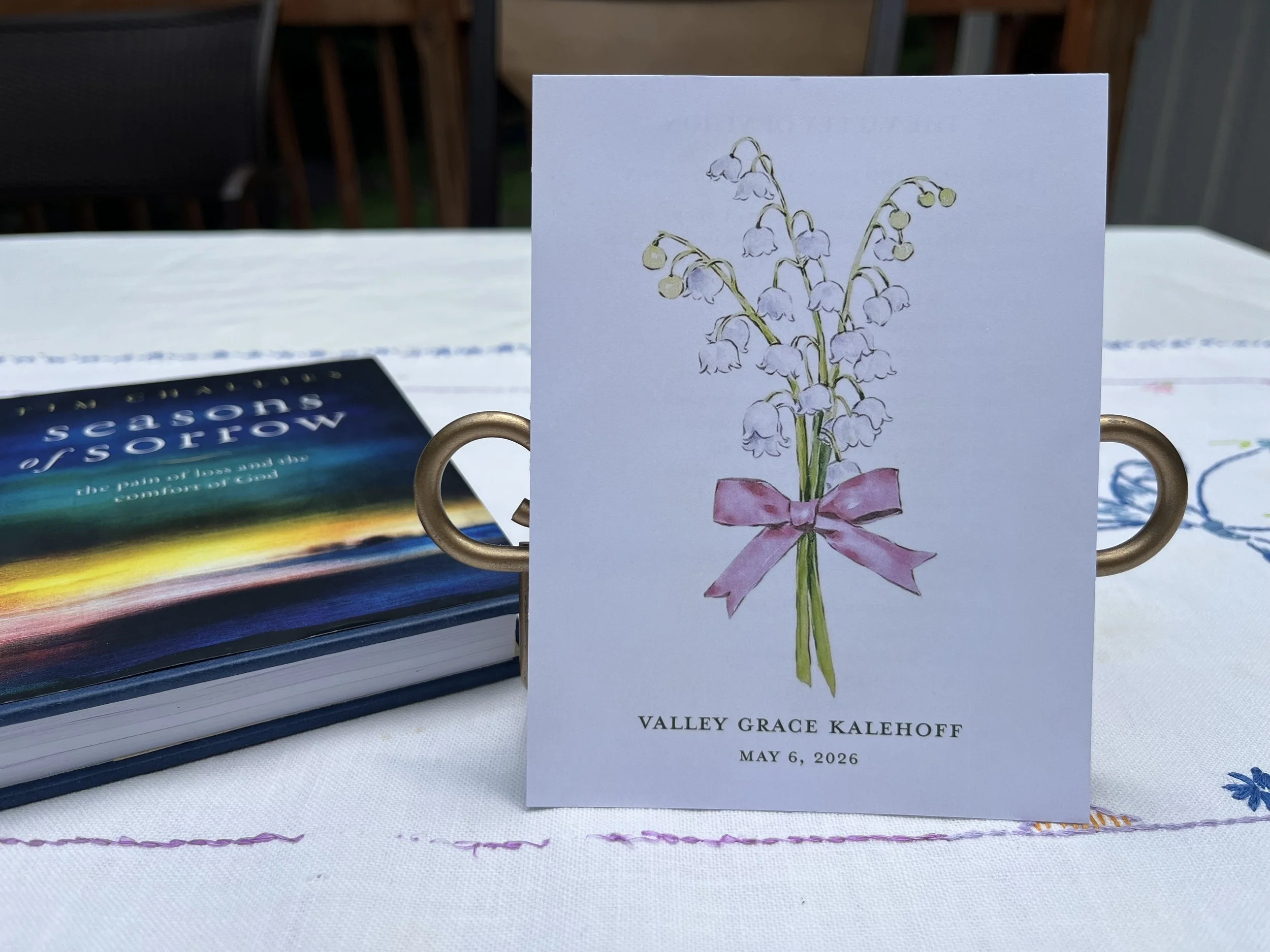
Inside my friend’s thank you note, I also found a beautiful birth announcement for Valley Grace. The sweet card commemorated Valley Grace’s life and death with both her name and “May 6,2026.” On the back of the card were these words from The Valley of Vision:
LORD, HIGH AND HOLY, MEEK AND LOWLY,
Thou hast brought me to the valley of vision,
Where I live in the depths but see thee in the heights:
Hemmed in by mountains of sin I behold thy glory.
Let me learn by paradox
that the way down is the way up,
that to be low is to be high,
that the broken heart is the healed heart,
that the contrite spirit is the rejoicing spirit,
that the repenting soul is the victorious soul,
that to have nothing is to possess all,
that to bear the cross is to wear the crown,
that to give is to receive,
that the valley is the place of vision.
Lord, in the daytime stars can be seen from
deepest wells,
and the deeper the wells the brighter
thy stars shine;
Let me find thy light in my darkness,
thy life in my death,
thy joy in my sorrow,
thy grace in my sin,
thy riches in my poverty,
thy glory in my valley.

I’ve written extensively about grief since James Bruce’s death. Grief is a process that changes you and much like labor, no one else can go through it for you. In the Valley of Grief, however, there are treasures of darkness to be found. Treasures of Darkness are those hard truths that God teaches us in our suffering, grief, pain, and loss that are seldom learned in the lighter, easier seasons of life. Much like diamonds found buried deep within the earth, treasures of darkness are hidden gems that are worth fighting for and finding during our pain, grief, and suffering.
My most valuable treasure from the last four years of our personal sorrow and grief has been an increased assurance of God’s goodness and faithfulness.
As Christians we do not grieve as the world grieves. God is with us. Those who are in Christ Jesus have the hope of the resurrection; the hope of God’s promises; the hope of his Word; the hope of heaven; and the comfort of the Holy Spirit. Hope is a faith that looks and leans forward. It is both an anchor and a lifeline amid our suffering grief, and loss.
Author Tim Challies writing in his excellent book Season of Sorrow after his own son’s death writes,
“The Christian faith offers the promise of a future in which this earth will be renewed and restored, in which all pain and sorrow will be comforted, in which all evil and sin will be removed…I know that I have said goodbye for now, that I have said farewell for a while, that Nick has not been sent away but merely send on ahead to that place where death is no more; where mourning, pain and sorrow are gone; where God has already wiped away every tear; and where my son is now waiting safely and patiently for his father to join him.”
“God is the God of all comfort.” (2 Corinthians 1:3)